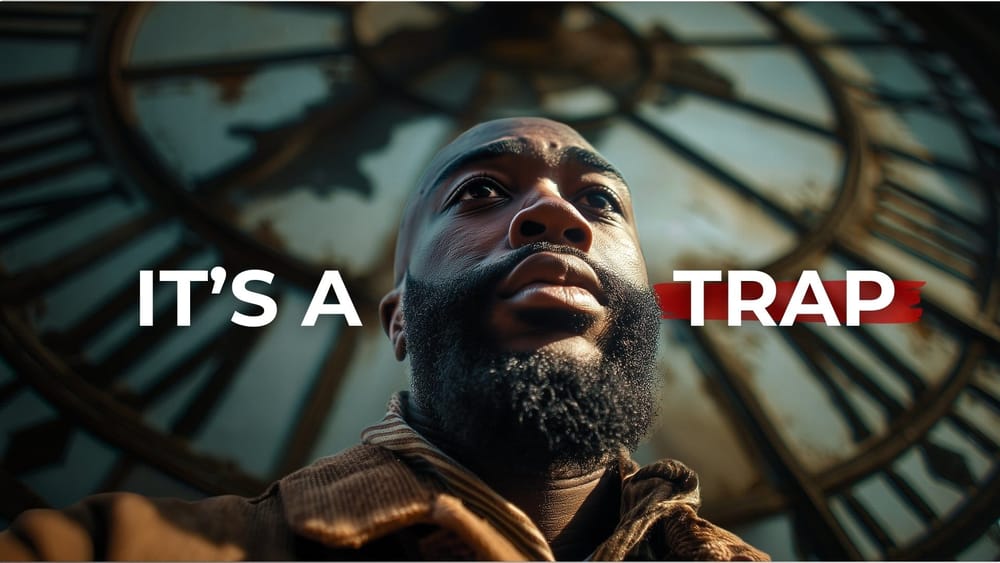


You don't make bad decisions because you're stupid; you make them because you compare your high-resolution reality to a low-resolution fantasy.
We often look at a new job, a new city, or a new relationship and think it will solve all our problems. But usually, we are comparing the messy, friction-filled reality we live in every day against a curated highlight reel of something we barely understand. In this episode, we break down "The Clarity Gap" and explore four practical frameworks to help you see the truth before you leap.
In this episode, we explore:
- 🌫️ The Clarity Gap: Why we overweight the upside of new options and ignore the downsides.
- 📝 The Three Lists: A simple method to separate what you know from what you assume.
- 🗣️ Disillusioned Insiders: The three specific questions you must ask people who have already done what you want to do.
- 💀 The Pre-Mortem: How to bypass your brain's optimism bias by planning for failure in advance.
🎧 Listen to the audio version:
- Listen in your favourite player:
- Listen on Spotify:
- Watch on Youtube: https://www.youtube.com/watch?v=l65j3lhOdbU
📄 Show Notes & Timestamps:
- [00:00] Introduction: Why the grass always looks greener
- [01:05] Defining The Clarity Gap (High Res Reality vs. Low Res Fantasy)
- [02:47] Method 1: Model Downside at Equal Resolution
- [05:15] Method 2: The Three Lists (Know vs. Assume vs. Don't Know)
- [06:49] Method 3: Seeking Disillusioned Insiders
- [11:41] Method 4: The Pre-Mortem Exercise
- [14:13] Conclusion: Decision making is about seeing clearly
The Clarity Gap Defined You know your current life in high resolution—you feel every commute, every annoyance, and every moment of friction. But when you look at an alternative (a new city, a new job), you see it in low resolution. You are stitching together a fantasy based on Instagram posts, travel vlogs, and assumptions. This causes you to overweight the upside and ignore the inevitable downsides.
How to Close the Gap To make better decisions, you must bring both options into equal focus.
- Model Downside at Equal Resolution: Don't just dream of the salary; ask what a "bad week" looks like in that new job. Visualise the commute, the stress, and the isolation with the same fidelity as you view your current problems.
- The Three Lists: Draw three columns—What I Know (evidence-based), What I Am Assuming, and What I Don’t Know. You will likely find that most of your "certainty" is actually just assumption.
Seeking Disillusioned Insiders Don't just ask people if they like their new life (they will likely give you the "Instagram answer"). Find people who have made the move you are considering and ask them:
- What did you not know before you started?
- What do most people misunderstand about this?
- What is the one thing you would do differently?
The Pre-Mortem Before you commit, assume the decision has already failed. Ask yourself: "It is one year from now, and this was a disaster. Why?" This forces you to surface hidden risks and prepare for them, rather than being blinded by optimism.
👨🏾💻 About David Elikwu: David Elikwu FRSA is a serial entrepreneur, strategist, and writer. He explores how to think deeper and work smarter atThe Knowledge.
🔗 Connect & Resources:
- Newsletter:https://theknowledge.io
- Free Guide (Seven Frames):https://sevenframes.io
- Course (Decision Hacker):https://decisionhacker.io
- Twitter:@Delikwu
- Instagram:@delikwu
📜 Full transcript:
[00:00:00]
Introduction and Confession
Speaker: I have a confession to make. Now. I write this semi-popular newsletter on productivity, creativity, and decision making. And recently someone asked me a question that made me think for the first time in a while about something that I had really taken quite for granted. So the confession is that for a long time I was actually deeply skeptical of this supposed explosion in A DHD diagnoses.
And so from my. Very high horse. It felt like an over-diagnosis for a coddled generation, everyone suddenly wants to have some kind of ailment, some kind of ouchie. They want a way to feel special. They wanna have a label to blame things on. This was my supposed hypothesis.
Shifting Perspectives on ADHD
Speaker: But actually my perspective has started to shift.
Quite recently when I was watching a video, it was about ordinary people discussing their favorite daily objects and, uh. These were just run of the mill [00:01:00] souls, not neurodivergent in any way at all. I don't think any of these people would ever describe themselves or claim to have a DHD, and yet all of them, when I watched this video and I watched the things that they described, all of these behaviours seemed eerily familiar.
All of them described in some way or another. This need to have two screens while eating an inability to focus on a book for a few minutes, or maintain a journal for more than a few days. This switchy impulse that everyone seems to share, including myself or at times, to pull out a phone while you're queing at the supermarket.
This inability to sit with your own thoughts and think deeply. And I think that's when it finally landed for me that this problem might not just be about a specific neurological condition.
The real story here isn't just one of A DHD diagnoses being on the rise, the real [00:02:00] story is that A DHD adjacent behaviors have actually become the new societal baseline.
The Digital Society as an Attentional Pathogen
Speaker: This brings us to perhaps a difficult thesis that the modern A DHD epidemic is not a crisis of individual brains, but a crisis of collective environment.
That our digital society has become an attentional pathogen, an environment that is so perfectly engineered for speed and distraction, that it sickens our collective ability to focus. The thesis is that we aren't failing the environment. The environment is failing us. And to understand this, we need to ask a series of questions and we're gonna go through only three.
The first question is.
Questioning the Nature of the Pathogen
Speaker: What is the nature of this pathogen? If this claim really holds weight, if this is really true, if it's believable, what exactly are we talking about here and how did we get to this place? Is it merely some accident? Did it happen by chance, or is this intentional?
Is there some [00:03:00] deeper conspiracy afoot? Is this actually the work of a machine? Is this world of distraction something that happened to us or something that was done to us? That's the question. And so I think there are two paths, path A, path B, and we'll follow a similar train for the other questions that we ask.
Path A: The Accidental Machine
Speaker: So here, path A is that this is a tragic accident. There was a French philosopher called Paul Lia writing back in the 1970s, and he predicted something along these lines. He coined the term ology. Which is the logic of speed. He argued that as technology accelerated our society, it would also simultaneously fundamentally alter human consciousness.
And so we begin with this rather noble goal. We want progress, we want connection, efficiency, et cetera. We build the internet, we build the global information superhighway, I think it was originally called, something like that. We have the internet, we have smartphones. We have global networks of connective systems.
[00:04:00] We have logistics systems that span across the world. We build all of these things to make life faster, better, easier. But Lio warned of what he called the accident of time, and he believed that the inevitable side effect of all of this speed would be the destruction of our ability to experience duration.
And his fear was that we would become trapped in a perpetual, stimulated present, unable to think long-term, or to reflect deeply.
And in this view, the architects of our world were more naive than malicious. This was nothing done to us intentionally, but. The people were trying to build a better future. They were trying to build a more connected world. The analog is that they built a spectacularly fast car without realizing that it had no brakes.
And so our current crisis is simply just the wreckage [00:05:00] of this unforeseen crash. That we built these systems. You are seeing this perhaps a lot with ai. There are many fears today that AI is making children and many of us dumber, right? IQ is falling for the first time in decades and decades of, of the research that we have,
And so Path A would argue that this is not done intentionally. This has happened. By chance, AI was supposed to give us a brighter future, AI and many other. Trends, robotics, automation, et cetera. These things were meant to aid us a long time ago.
You can actually go to the knowledge.io and search for artifact. I wrote about this idea of cognitive artifacts. I'll give you a few examples. This pen here I'm holding in my hand if you're watching this on YouTube. Beautiful pen. One of my favorites, a Pelican M 600, and this is a cognitive artifact because.
When we had pen and we had paper, it allowed us to [00:06:00] offload something that we typically would've done. In our minds, we offload the mental effort of doing some of that work, and we bring it into a physical space and it's done somewhere else. So instead of simply trying to memorize long stories, memorize poems, memorize.
The thoughts in my mind, memorize my ideas. I can write them down and when I write them down, I can build catalogs that we now call books. I can build these tools that I can use to aid my thinking instead of having to think and keep everything in my mind. So it's a cognitive artifact. And you might think of a computer the same way.
Another cognitive artifact you might see behind me if you're watching on video, I have an abacus somewhere there above my head, and that is also a cognitive artifact. An Abacus helps you to do math. Nobody really uses them in the west anymore, but you can essentially move some tiles up and down along these little poles, and it allows you to add and subtract [00:07:00] and do different types of mathematics.
But the problem is an abacus is not the same as a calculator, which might have been the natural thing that you would've called to mind following the Abacus. And that's because in this framing that I wrote about, there are actually two types of cognitive artifacts. There are complimentary ones and there are competitive ones.
The pen is a complimentary artifact. It aids your thinking. It's an artifact. Yes, it is offloading some of your thinking ability, your processing is coming out of your brain and into some physical form, but by writing, especially writing in cursive. There is geospatial reasoning. In addition to the purely logical reasoning, there are multiple parts of your brain being activated.
And so actually in as much. As you are able to do one thing faster and more efficiently because you are offloading some of your brain process, you are also activating other parts of your brain, and so in some this year is actually better for you. Right? It, it's an artifact. It's [00:08:00] something you can use as a tool to help your brain, but it helps you.
And Abacus works the same way. It also has this tactile, geospatial element to it. Walking also works the same way. Walking helps your heart, it helps your brain, et cetera. And so walking is also perhaps a cognitive artifact in the same way, in a way that the GPS is not. The GPS is also a cognitive artifact, but it's competitive.
It doesn't help your brain when you offload something to the GPS. You are now no longer doing any work at all with your brain. And so it competes with your cognitive reasoning. You delegate the reasoning completely to the GPS. When you use a map instead of a GPS, you are still doing geospatial reasoning.
You are still having to navigate, look at landmarks, et cetera. And so it's useful. It's a cognitive artifact, but it's complimentary. It makes your brain stronger. It makes your brain better when you take it away. If you've only learned to use a calculator, if I take the calculator away, [00:09:00] your brain is weaker.
If you've learned to use an abacus like the one I have here, if I take the abacus away, you are actually better at doing math. If you learn to use a map and I take the map away, you are better at navigating than you were before you had the map. If I give you a GPS and I take the GPS away, you are worse.
You. You can see how this trend continues and so. Returning to our question and our framing here, what we've largely been discussing is this first path, this idea that much of this can happen by accident. We can build with these tools that we think will help us, that we think will aid us, that we think will make us better.
And there could be unintended consequences, but that's not the only. Argument here, the path B is slightly more cynical.
Path B: The Deliberate Machine
Speaker: It's that this collective pathogen, this thing that we face, this, you know, the growth in A DHD diagnoses perhaps is actually a deliberate machine. This path would argue that the state of [00:10:00] distraction that we have is not an accident at all, but instead a calculated, intended outcome of a multi-trillion dollar attention economy.
And following this train of thought, the goal was never simply connection. It was actually the systematic harvesting and monetization of human focus. Wow. Maybe I'm setting myself up too much. Maybe you might cry out and say, whoa, whoa, whoa. Isn't this a bit crazy? Are you not overcooking things here, but allow me to.
State the claim, make the case. So in this view, every notification, every infinite scroll, every autoplay, video, all of these tools, these dark patterns that's what they're called in UX design. All of these things are meticulously engineered cogs in a machine that's designed for one purpose alone, which is to fragment your attention and sell the pieces to the highest bidder.
Are we getting somewhere? So in this [00:11:00] frame of thinking, the architects of this system weren't merely naive. They were actually ruthlessly effective capitalists. They understood that a mind that can't focus is a mind that is easy to influence. And so your attention, your focus has been sold to the highest bidder.
It has become a product. It has become.
Resource for the profiteering of shareholders. And so in this view, perhaps the system isn't broken at all. Perhaps it's working exactly as it was designed.
But let's not get too carried away just yet. You might be thinking, okay, and so what if it's true? What if we accept this hypothesis? I've merely stated a claim here. We haven't necessarily gone too far. Show me the harm. Show me the hurt. What is the consequence.
Show me the wounds in the flesh. And so let's talk about what does it matter? Okay, fine. So, so what, right, so what? There were more a [00:12:00] DHD diagnoses than there were before. So what if you might have slightly less attention span because your brain is competing with the computer. So what if some shareholders happen to profit from your lack of attention?
What do we lose?
The Consequences of Fragmented Attention
Speaker: And so again, I bring you two paths, path A, path B, the loss of the self or the loss of the world. If our attention is truly being eroded, what's the most profound thing that we stand to lose? path A would argue that the deepest loss is actually internal.
What we are losing the self. A would argue that sustained deep attention is the prerequisite for a stable sense of who we are. It's the thread that we use to weave together our memories and to form a coherent life story. Our internal monologue, our ability to focus and think is the means by which we cultivate a rich in a world.
And without that. Without focus, [00:13:00] without concentration, without attention, we become what TS Elliot described decades before the smartphone as being distracted from distraction by distraction. And once we lose our attention, once we lose our focus, we become hollowed out. If this thesis proves out, this claim that I've made, if it's true, what we lose is our soul.
We become these hollow shells. We live in this reactive, perpetual present. We are unable to connect with our own past or plan for our future. And the ultimate cost. Here is our own interiority.
The spiritual emptiness that so many people feel today is the direct result of this internal collapse. We can no longer sit quietly with our own thoughts because the quiet space inside your mind has been strip-mined for engagement and shareholder profit. people can't read books anymore. People don't even know what this is, and it's crazy.
I was writing about this in my newsletter, the idea that. [00:14:00] Mere centuries ago, the thing that stopped most people reading was literacy or poor eyesight. Okay? Slaves yearned to be able to read. They weren't taught how to read. It was seen as a form of power, and now people are happily powerless. People are happy to say, oh, they're actually books.
You want me to just waste my time reading books when I could be watching Netflix? God. But this is where we are now. You understand, you know, maybe I shouldn't have wasted my time writing this brilliant book, if I may say so myself, and so do the, the blurbs on the back. Um, I'll stop pumping my book, but hey, I think it's a great book.
It's a book called Sovereign on Self Authorship. I guess it's about how to take control of your life and maybe I'll bring it up again later. But anyway, that's path a. That we are losing the self, that that is the crime here, that that is the cost of living in this attention economy. But path B actually takes [00:15:00] this a step further, and path B says, maybe that's the least of your worries.
Oh, little child. How, how cute, how quaint that you think that the greatest loss. The attention economy is merely your inner monologue, your interiority, your sense of self, your moral compass, how quaint it is that you believe that that is all that is at stake, that you believe that that is all you have to lose.
If only it was that simple. path B would say that actually the most dangerous consequence is the erosion of our ability to understand and solve collective problems. That actually your loss of your ability to to think deeply and have some interiority is actually just scratching the surface. Because when we think on a societal level, deep attention is how we grapple with problems.
It's how we grasp complexity, whether it's the nuance of a political argument, whether it's [00:16:00] the intricacies of climate science or the depth of a great work of art. Attention and focus is how we solve collective problems. We've had the Manhattan Project, we've had the COVID epidemic. We've had many of these times when we've had to pull together.
We've had great wars that require many people thinking as one thinking in unison minds working overnight over time. Focused on a single problem at great speed, at great pace being pushed to solve these problems. And now potentially we have this future where there are no minds, there are no human minds, there are onlys, synthetic ones, minds of silicon.
And perhaps the next great pandemic that we face, there will be no brains to solve it. We would merely switch on some AI and type into chat, GPT, Hey, we have this problem. People are dying. Please help us [00:17:00] come. What a world that might be.
Path B would argue that a society with pathologically fragmented attention cannot solve any of the long-term challenges that we may yet have to face. Our best hope is actually that the system is so efficient that the system takes care of the problems for us because God forbid, if not, if AI can't fix it, what happens to our brains if people can't read anymore?
If textbooks can't be? Delved into, if we can't digest information, if people can't focus for more than 15 seconds, how on earth do you solve tomorrow's problems? If our fragmented minds can only react to the latest 24 hour outrage cycle, we lose the ability to do what my newsletter calls good work. We lose the capacity.
Uh, actually, Cal Newport. Also wrote a book on this good, uh, deep work. It's a great book. I'd highly recommend it, but in this process, we would lose the capacity to [00:18:00] be effective citizens. And the cost isn't just a personal one, it's actually the degradation of a functioning civilisation. One tweet, one notification, one interrupted thought at the time
Now question three. Okay. Whew. Maybe you believe me by now, maybe there is something here. Maybe it does have some consequence.
Possible Solutions: Personal Monasticism vs. Public Reform
Speaker: What's the solution? What's the most viable response? What do we do with this quandary that we find ourselves in? And maybe there are two Paths, once again, personal monasticism on one side or public reform on the other.
So you might say, faced with this reality, how should we respond? Do we save ourselves or do we try to save everyone? Is it possible to save everyone? Maybe the best you can? Do? You know if the world works one way, if your company, the place that you work, the thing that you do is fueled by this endless need for more.
If you feel stuck on this treadmill, is it possible to pull [00:19:00] everyone off that treadmill? Maybe it's only possible to extract yourself. So Path A here. Would make the case for personal monasticism. This path would argue that if the environment is truly pathological, if it is true that the baseline of.
Where everyone in society is being driven is toward these A DHD adjacent behaviors. And, and mind you, let's just pause here for a brief interjection. I'm not saying that being a d ADHD is the worst thing in the world. That's not really the point. The point is what happens if everyone has a DHD? And actually, when you look at the data about the, the trends here, it is actually notable that there is no great growth.
Below age five. So age five is trending as it always has, but actually above that age, which is typically these days, the age people are giving their children iPads to get them to shut up. That is the age that suddenly you have this uptick in attention. Hyperactivity [00:20:00] disorder. People losing their ability to focus, to concentrate all of the great ills that we hypothesized earlier.
This is really what we're talking about is the quandary here. And so coming back to the point, Path A would argue that, you know, if this is truly pathological, that the only rational response is a strategic personal withdrawal. Okay. Everyone out there, they are lost, but you can save yourself. This is the modern equivalent of medieval monks.
They understood that contemplation was fragile. They knew that the outside world was full of distractions, both worldly and spiritual. And so monks, they built monasteries. They built thick stone walls to create a space where deep thought was possible.
And so perhaps the modern solution as many advocate online is building and curating your own digital monastery. Maybe this means that you have to aggressively curate your digital inputs. I have personally advocated for this in the past, I've written about this, but it means [00:21:00] turning off your notifications.
It means scheduling deep work. It means cultivating analog habits like reading physical books and journaling by hand. And so the focus here is on your own. Individual salvation is about protecting your mind from the sick society outside. Can you do it? Is it possible? Give it a try. Path B on the other hand, is the case for environmental reform.
This is perhaps to say that it is not enough to save yourself. It is not enough to save one soul in a sick society. Actually, if society crumbles, then we all lose that. The individual solutions, may be cute, they may be useful. They're like telling people to just breathe less in a polluted city.
It is not an option, not a long term one Anyway. If the problem is environmental, then the solution must similarly be systemic. You can't meditate your way out of a system that's designed to addict you. [00:22:00] This is what path B would argue. And so the solution here would call for a collective public health style campaign.
We already regulate addictive substances like tobacco and alcohol. We have public health campaigns for healthy eating and for exercise. And so actually, perhaps what is most needed is to treat our attentional crisis with the same level of alacrity, with the same level of suitable dismay and alarm.
And we should advocate for more humane technology design that demands regulations on the most addictive algorithms. And you see. Some of the early seeds of this in some schools, which are phone free schools, you see videos of people having to lock their phones in, in cupboards. Actually, these are quite popular.
Even my partner mentioned the other day that she might want one of these bricks, I think they're called, where it's a [00:23:00] small device that you hide somewhere in your home and you have to tap your phone on it to lock and unlock your phone. And so perhaps on a systemic level. These are the type of things that we need to organize.
These are the things we need to regulate for fear of the loss, both on a societal and collective level that might be greater than we can manage. Maybe we need to teach workplaces to value and protect deep focus. Treat it as the precious resource that it is. And making the focus, not just on saving yourself as an individual, but healing the environment itself, healing all of society.
And I think that's hard, but I truly think that the consequences of these changes in our society may be so much greater than we currently. Imagine if we were to follow our claims from earlier, and I would love to hear on all the paths that I've described, whether you agree, whether you disagree. I'd love to hear your [00:24:00] thoughts, your feedback, where you land on this spectrum.
I'm really just trying to present the claim. I'm trying to present the spectrum of thought, the different ways that these things could go, the different impacts these things can have, and I've. Tried to think about these things for a while, and I've written about it to some extent at the Knowledge, the knowledge.io, but I'd love to hear from you.
Conclusion: Balancing Personal and Public Responses
Speaker: So in conclusion, I mean, where does this leave us? Maybe the truth isn't found just in choosing one path over the other. Maybe the pathogen is both. Maybe it's an accidental machine, a system that started with good intentions but was quickly co-opted by ruthless incentives. And maybe the consequence is that we are losing both our inner and outer world simultaneously, that our souls and our societies are eroding in parallel.
And perhaps the only viable response requires both personal monasticism, this cultivation of deep work and [00:25:00] private focus, this protection of energy and attention in our personal lives, but also we need still this public health campaign.
We must build our own monasteries to keep our minds intact so that we have focus and sanity to fight for a healthier environment for everyone else. And perhaps there is something in this balance, in this duality that we can create something of a better future. So hopefully this wasn't too doom and gloom, but at least a cause to think deeper about how we use our time, how we use our attention, and the ways in which we might allow it to slip away.
Because ultimately the goal here, you know, we started by talking about A DHD. The goal here is not to simply diagnose ourselves, it's to diagnose the world that we've built. And the real question isn't whether you or I have a DHD,
the question is whether we are brave enough to acknowledge that the world we have built makes sustained attention nearly impossible, and [00:26:00] then decide if that's the world that we want to keep building.
Outro and Call to Action
Speaker: Who am I? I'm just a man asking questions. I'm David Eku, and this is the Knowledge. Subscribe for more on YouTube.
Wherever you are listening to this or in your favorite podcast player, you can get my book Sovereign on September 24th. You can pre-order it now, otherwise you can pick up a copy from September 24th. You can follow me and my Band of merry Brave Souls. 40,000 of us. Now we're getting stronger by the day. Uh, come and join us at theknowledge.io.
I also have a course on decision making. If you are trying to make the best decisions of your life, you can find that at decisionhacker.io. Hmm. Until next time. Oh. Give this a like if you are so predisposed. Thanks.